Microeconomics vs Macroeconomics: The Two Lenses That Explain Money, Markets, and the Economy
Understand microeconomics vs macroeconomics, how each explains money decisions, markets, jobs, inflation, and business opportunity.

Why This Difference Matters
Economics can feel abstract until you realize it is really a way of looking at choices. Some choices happen close to the ground: a family decides whether to rent or buy, a worker chooses how many hours to work, a business sets a price, a customer compares two products, a bank decides whether to lend. Other choices happen at the scale of an entire country or even the global economy: unemployment rises, inflation changes household budgets, interest rates move, government spending expands or contracts, currencies shift, and recessions reshape business plans.
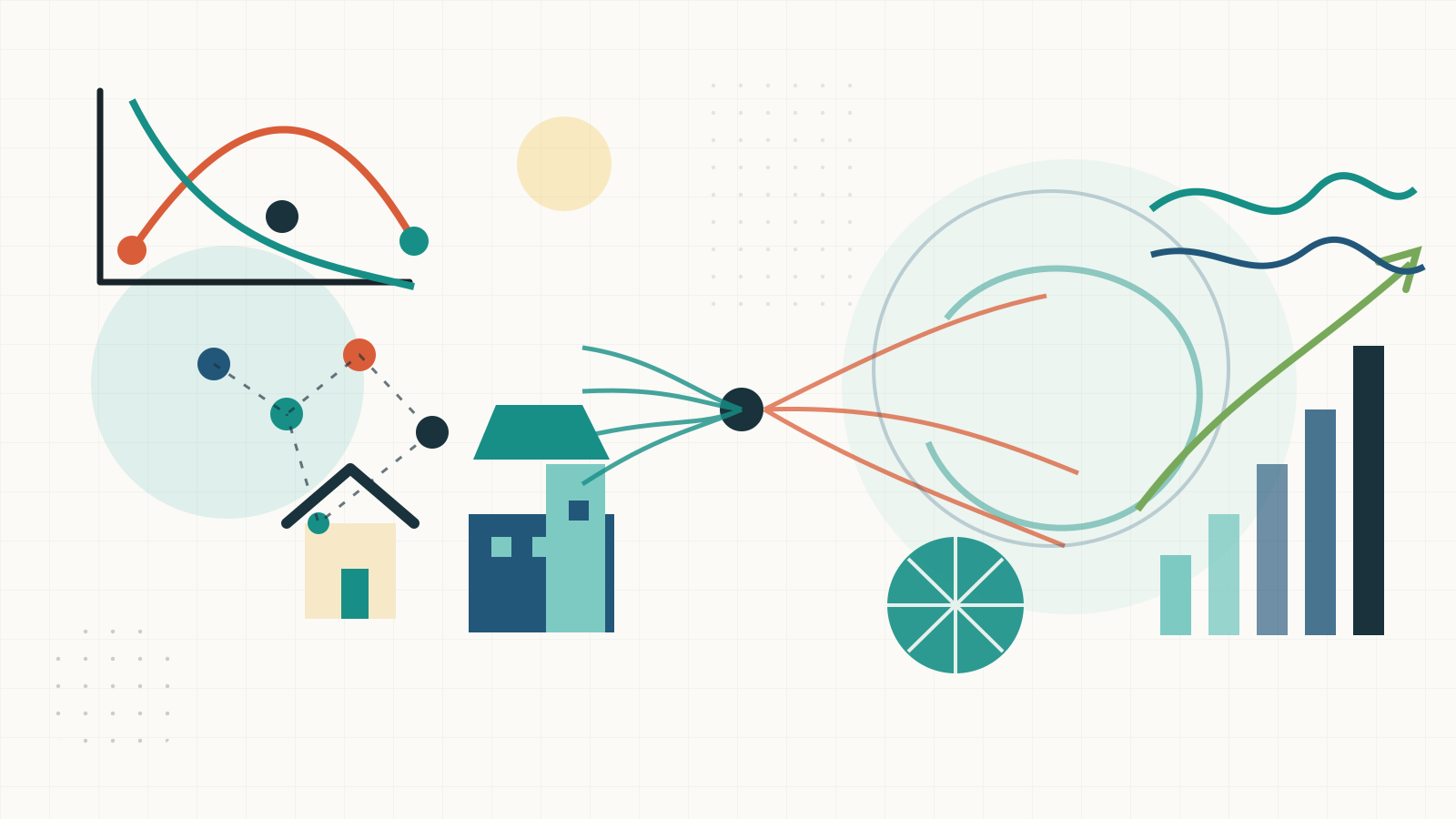
That is the simplest way to separate microeconomics from macroeconomics. Microeconomics studies decisions and interactions among people, firms, markets, and institutions. Macroeconomics studies economy-wide outcomes such as employment, growth, inflation, financial stability, and public policy.
The distinction matters because money problems often contain both layers. A household budget is microeconomic because it involves individual trade-offs, prices, wages, and preferences. But the same household budget is affected by macroeconomic forces: inflation, mortgage rates, job markets, taxes, and the business cycle. A small business pricing a product is making a microeconomic decision. But its suppliers, customers, credit costs, and demand may all depend on macroeconomic conditions.
The open-access economics project CORE Econ is useful because it teaches economics through real-world problems rather than treating the subject as a collection of isolated diagrams. Its book The Economy 2.0 frames microeconomics around actors, institutions, and outcomes, while macroeconomics focuses on employment, growth, and fluctuations. That framing is helpful because it shows that the two fields are not rivals. They are complementary lenses.
If you want to understand personal finance, business, investing behavior, public policy, or online markets, you need both. Microeconomics explains the decisions. Macroeconomics explains the environment in which those decisions become easier, harder, cheaper, riskier, or more profitable.
What Microeconomics Studies
Microeconomics starts with the individual actor: a person, household, worker, firm, lender, borrower, buyer, seller, manager, or customer. It asks how these actors make decisions when resources are limited and choices involve trade-offs.
A worker has only so many hours in a day. A household has a limited budget. A business has limited capital, employees, attention, inventory, and time. A customer cannot buy everything. Scarcity forces choices, and microeconomics studies how people make those choices.
CORE Econ’s microeconomics volume includes topics such as scarcity and working hours, strategic interactions, institutions, firms and employees, firms and customers, supply and demand, lenders and borrowers, and market failures. Those topics show the range of microeconomics. It is not only about prices. It is about power, incentives, rules, contracts, competition, information, cooperation, and conflict.
For example, supply and demand is microeconomics because it explains how buyers and sellers interact in a market. If more people want a product and supply is limited, prices may rise. If competitors enter and supply increases, prices may fall. But that simple model becomes richer when you add real-world details: customer loyalty, brand trust, search costs, product reviews, platform algorithms, shipping delays, and unequal information.
Microeconomics also studies firms. A firm has to decide what to produce, how much to charge, whom to hire, how to motivate employees, which customers to target, and whether to invest in new technology. These decisions are not made in a vacuum. They are shaped by institutions: laws, contracts, norms, property rights, competition rules, and financial systems.
This is why microeconomics is so useful for everyday business thinking. If you run an affiliate site, an ecommerce shop, a newsletter, a local service business, or a freelance offer, you are making microeconomic decisions constantly. What is the customer problem? How much are people willing to pay? Who else solves it? What makes your offer different? How hard is it for buyers to compare options? What information do they need before trusting you?
Microeconomics turns those questions into a disciplined way of thinking.
What Macroeconomics Studies
Macroeconomics zooms out. Instead of starting with one buyer, one worker, one firm, or one market, it looks at the whole economy. It studies aggregate output, unemployment, inflation, interest rates, government budgets, financial markets, economic growth, recessions, and global connections.
CORE Econ’s macroeconomics section focuses on employment, growth, and fluctuations. Its units cover unemployment and real wages, aggregate demand, inflation and unemployment, macroeconomic policy, debt and money, the financial sector, the global economy, economic crises, uneven development, and government as an economic actor.
Those topics are the backdrop to personal financial life. Inflation changes what a paycheck can buy. Unemployment changes bargaining power. Interest rates affect mortgages, credit cards, savings accounts, business loans, and asset prices. Exchange rates affect imports, travel, and global suppliers. Government policy affects taxes, transfers, public services, infrastructure, and business incentives.
Macroeconomics also explains why good individual decisions can still be overwhelmed by broad conditions. A careful worker may still lose a job in a recession. A well-run small business may struggle when demand falls across the economy. A household may budget responsibly but still face pressure if rents, food, insurance, and borrowing costs rise faster than wages.
This does not mean individuals have no agency. It means agency exists inside conditions. Macroeconomics helps you understand those conditions.
A key macroeconomic concept from the CORE Econ glossary is aggregate demand, the total spending on goods and services produced in an economy. When aggregate demand weakens, firms may sell less, cut production, delay hiring, or reduce hours. When demand strengthens too quickly relative to supply, inflation pressure can rise. These economy-wide movements affect local businesses and household decisions even when no single person caused them.
The Practical Difference
The easiest way to remember the difference is this: microeconomics asks what happens inside markets; macroeconomics asks what happens to the economy as a whole.
Microeconomics asks why one product sells better than another. Macroeconomics asks why consumers are spending less across many categories.
Microeconomics asks how a firm should price a service. Macroeconomics asks whether inflation and interest rates are changing what customers can afford.
Microeconomics asks why workers accept, reject, or negotiate job offers. Macroeconomics asks why unemployment is rising or falling.
Microeconomics asks how a landlord and renter interact in a housing market. Macroeconomics asks how mortgage rates, construction, wages, migration, and credit conditions affect housing broadly.
Microeconomics asks whether a creator can make money reviewing kitchen products. Macroeconomics asks whether consumer confidence, household debt, and retail spending make that niche easier or harder.
Both lenses are useful. Microeconomics gives you the close-up. Macroeconomics gives you the weather report.
How Micro and Macro Connect
The two fields are separate for teaching purposes, but the real economy does not keep them in separate boxes. Individual choices add up to aggregate outcomes, and aggregate outcomes shape individual choices.
Consider inflation. At the macro level, inflation is a general rise in prices across the economy. But it is experienced through micro decisions. A grocery store raises prices because supplier costs changed, wages changed, demand changed, competition changed, or margins became too thin. A household responds by switching brands, buying less, delaying purchases, or searching for discounts. A business responds by changing prices, packaging, suppliers, staffing, or product mix.
Now consider employment. Macroeconomics measures unemployment across the economy. But unemployment is built from millions of micro-level interactions: firms deciding whether to hire, workers deciding where to apply, wages being negotiated, skills matching or failing to match job openings, and institutions shaping job search and training.
The same is true for credit. A single loan is microeconomic: a lender, borrower, interest rate, collateral, risk, and repayment plan. But credit conditions across the economy are macroeconomic. If banks tighten lending or central bank policy changes interest rates, many individual borrowing decisions change at once.
This is one reason CORE Econ’s approach is useful. It does not treat economics as only abstract equilibrium. It emphasizes institutions, power, inequality, instability, and environmental limits. That matters because money decisions are never purely personal. They are personal decisions made inside systems.
Why Personal Finance Needs Both
Personal finance often gets reduced to individual discipline: save more, spend less, invest consistently, avoid bad debt. Those habits matter. But a purely micro view can become misleading if it ignores macro conditions.
A person’s ability to save depends on income, prices, housing costs, health expenses, childcare, taxes, debt costs, job stability, and family obligations. Some of those are individual choices. Many are shaped by the broader economy.
Microeconomics helps you improve decisions within your control. You can compare prices, negotiate wages, reduce waste, understand incentives, avoid bad contracts, and choose products carefully. Macroeconomics helps you understand the pressures outside your direct control. You can think about inflation risk, emergency funds, interest-rate sensitivity, job-market cycles, and how exposed your income is to downturns.
For example, deciding whether to take a variable-rate loan has a micro side: your budget, risk tolerance, credit score, and contract terms. It also has a macro side: interest-rate conditions, inflation expectations, central bank policy, and the possibility of income shocks.
Building an emergency fund also has both sides. At the micro level, it is a personal buffer. At the macro level, it is protection against recessions, layoffs, medical costs, price spikes, and credit tightening.
A better personal-finance mindset is not “everything is my fault” or “everything is the economy’s fault.” It is: what can I control, what conditions am I operating inside, and how do I make decisions that survive both?
Why Business Owners Need Both
A small business owner lives at the intersection of micro and macro economics every day.
Microeconomics helps with pricing, positioning, customer research, product design, retention, competitor analysis, hiring, incentives, and margins. If you sell a product, you need to know what customers value and what substitutes they compare you against. If you sell a service, you need to understand willingness to pay, trust, differentiation, and the cost of delivery.
Macroeconomics helps with timing and risk. Are borrowing costs rising? Are consumers cutting discretionary spending? Are suppliers becoming more expensive? Is unemployment changing the labor market? Is inflation forcing customers to trade down? Are currency moves affecting imported goods?
A product-review publisher, for instance, might use microeconomics to understand buyer intent: which features matter, what questions people search, and why one product beats another. But macroeconomics helps explain whether shoppers are upgrading, delaying purchases, looking for budget alternatives, or seeking products that save energy and time.
A freelancer might use microeconomics to set packages and negotiate contracts. Macroeconomics helps explain why clients cut budgets in some periods and invest aggressively in others.
A local service provider might use microeconomics to optimize routes, prices, and customer acquisition. Macroeconomics helps explain fuel costs, wage pressure, housing-market demand, and credit availability.
The practical advantage is not academic. When you understand both lenses, you make fewer shallow explanations. You stop saying “people are cheap” when the real issue is falling disposable income. You stop blaming “the economy” when the real issue is weak positioning. You get better at separating product problems from market conditions.
A Simple Way to Use Both Lenses
When looking at any money question, ask two sets of questions.
First, ask the micro questions. Who are the actors? What choices do they face? What are the incentives? What are the trade-offs? What information is missing? Who has bargaining power? What institutions or rules shape the interaction? What prices are changing? What substitutes exist?
Then ask the macro questions. What is happening to income, employment, inflation, interest rates, credit, government policy, and overall demand? Is the economy expanding, slowing, or unstable? Are global markets affecting local prices? Is this a temporary shock or a structural change?
Take a trending product as an example. The micro questions tell you whether customers want it, what problem it solves, how competitors price it, and whether affiliate content could convert. The macro questions tell you whether households are likely to buy premium versions, look for budget alternatives, delay purchases, or favor products that promise savings.
Take a career decision. The micro questions involve your skills, wages, negotiation options, and employer fit. The macro questions involve job-market strength, industry cycles, inflation, and interest rates that may affect company hiring.
Take investing. The micro questions include a company’s profits, competitive position, costs, management, and pricing power. The macro questions include interest rates, inflation, growth, financial stability, and policy.
This two-lens habit does not make the future predictable. It makes your reasoning stronger.
Final Takeaway
Microeconomics and macroeconomics are not two competing versions of economics. They are two levels of explanation.
Microeconomics helps explain how people, firms, and institutions make choices under constraints. It is the economics of prices, incentives, trade-offs, contracts, competition, information, and bargaining power. Macroeconomics helps explain economy-wide outcomes: employment, growth, inflation, recessions, financial markets, public policy, and global shocks.
For personal finance, microeconomics helps you make better decisions. Macroeconomics helps you understand the conditions around those decisions. For business, microeconomics helps you serve customers and protect margins. Macroeconomics helps you prepare for demand shifts, credit conditions, inflation, and downturns.
The useful question is not which one matters more. The useful question is which lens you need first. If the problem is about a buyer, seller, worker, firm, price, or contract, start with microeconomics. If the problem is about jobs, inflation, growth, interest rates, recessions, or policy, start with macroeconomics.
Then bring the other lens back in. That is where economics becomes most practical: not as a theory floating above real life, but as a clearer way to understand the money decisions people make every day.
Sources: CORE Econ, The Economy 2.0, CORE Econ Glossary
How to Read Economic News Without Getting Lost Inflation and Personal Finance: What Actually Changes How Market Demand Shapes Small Business Ideas